Labor & Employment
Rising Job Openings but Falling Hiring: The Growing Mismatch That Keeps the Fed — and Workers — in Limbo
By Staff · July 7, 2026
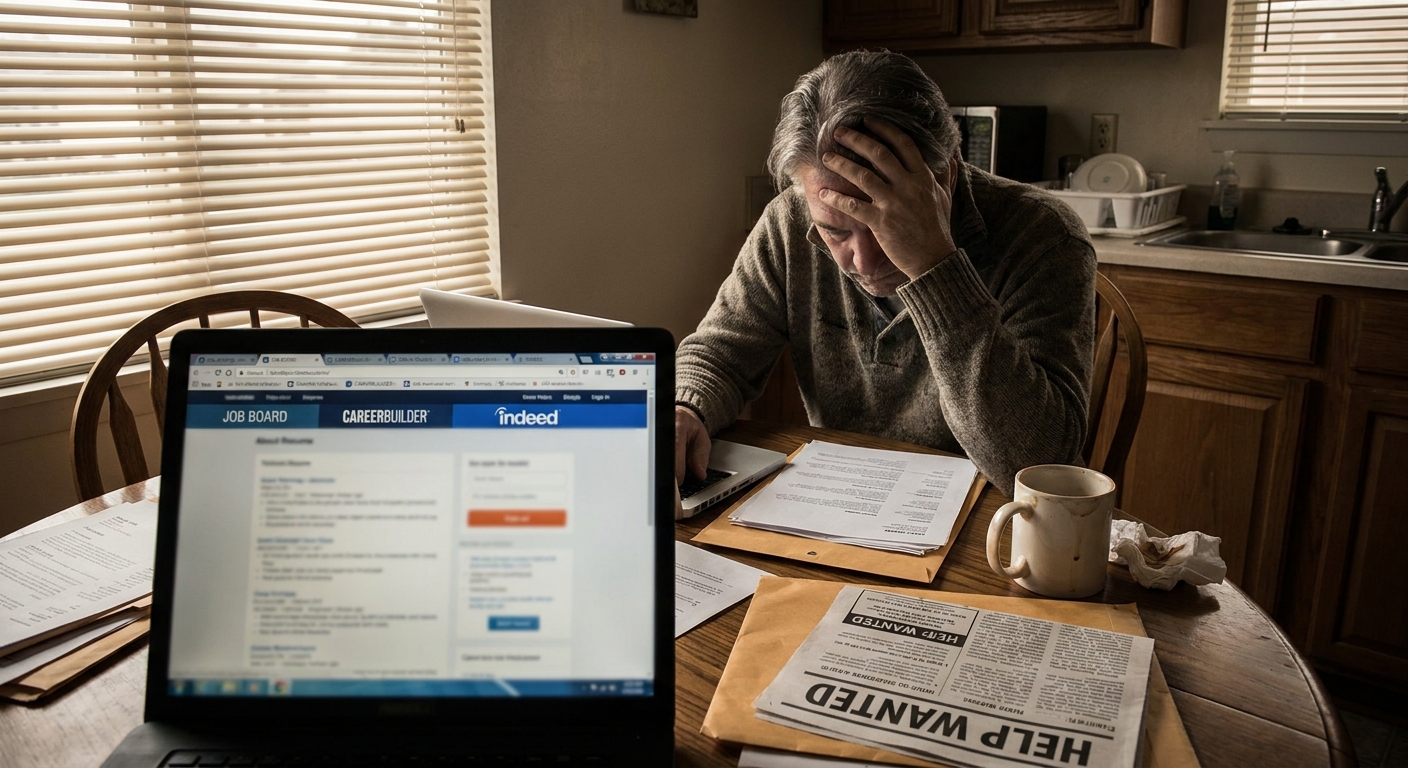
A machine operator in Ohio submits hundreds of applications over four months and hears nothing. A small business owner in Texas can't afford a loan at high rates to hire the worker she needs. A 32-year-old accountant in Atlanta gives up looking after a year and leaves the workforce entirely. Meanwhile, the Federal Reserve looks at 7.6 million job openings and decides the labor market is too hot to lower interest rates.
This is the paradox crushing American workers and small businesses in 2026: more jobs are supposedly available than at any time since 2024, yet fewer people are actually getting hired each month. In June, U.S. employers added just 57,000 jobs while 720,000 workers left the labor force—most after exhausting themselves in a search that yields phantom opportunities rather than paychecks. The average job seeker now submits around 162 applications to land one job, with many needing 150 to 300. About 6 million people sit outside the labor force still wanting a job, including 477,000 discouraged workers who have stopped looking because they believe no jobs are available for them.
This is not a story of recovery. It is a breakdown in the basic compact of a functioning labor market: that employers genuinely seeking workers will find them, and that workers willing and able to work will find jobs. The consequences land squarely on workers, small businesses, and families—while the Federal Reserve, reading rising job openings as a green light to keep borrowing costs high, prolongs the squeeze.
A Market That Looks Healthy on Paper but Feels Broken
June's 57,000 jobs were far below the 110,000 economists had expected and marked the lightest month of hiring since February. Despite 7.6 million job openings in May, actual hires remained subdued at just 5.2 million, unchanged from April. Job openings rose for a second consecutive month, signaling a persistent trend rather than a one-month anomaly.
The unemployment rate fell to 4.2% from 4.3% in May, but the drop was hollow—driven by workers leaving the labor force rather than by stronger hiring. Labor force participation dropped 0.3 percentage points to 61.5%, its lowest level since March 2021 and the lowest non-COVID reading in 50 years. Prime-age participation (ages 25–54) fell 0.6 percentage points to 83.3%, indicating this is not about retirements. It is about workers in their most productive years dropping out because the system has failed them.
Earlier months' job growth was revised down by a combined 74,000 jobs. Former Federal Reserve Chair Jerome Powell captured the bind last April: "The labor market is in an unusual and uncomfortable kind of balance where the unemployment rate is low (4.3%) but hires are really low, quits are really low, and there is effectively no new net job creation."
The Skills Mismatch—or the Selectivity Surplus?
Analysts attribute the gap between openings and hiring to a skills mismatch, with employers requiring precise skill fits. According to the 2026 ManpowerGroup Talent Shortage Survey, 74% of employers globally report difficulty finding workers with the skills they need. EY Economist Gregory Daco observed: "Hiring has been highly selective, but job growth has improved since last year's weakness." ADP Chief Economist Nela Richardson noted: "There are signs of labor supply constraints in certain industries."
Yet the number of people unemployed for 27 or more weeks rose to 1.9 million, up 286,000 over the year—suggesting employers' pickiness, not a genuine scarcity of willing workers, is driving the mismatch.
The labor market is cooling through weaker hiring rather than a surge in layoffs, with quits and layoffs holding near recent ranges—a pattern that shifts power to employers who can afford to leave positions open rather than compromise on narrow skill requirements or wage expectations. LPL Chief Economist Jeffrey Roach pointed to underutilization: "Firms are still adding to their payrolls, but hours worked are below pre-pandemic levels." Employers are hoarding the optionality that comes with job openings while avoiding the commitment of actually filling them.
Indeed Hiring Lab economists warned: "If the mismatch in skills persists, hiring is likely to remain stagnant"—a forecast that implicitly places the burden on workers to mold themselves to employers' specifications rather than on employers to adjust wages, training, or expectations to meet the labor pool that exists.
The Fed's Trap: Reading Phantom Openings as Real Tightness
Kevin Warsh became Chair of the Federal Reserve in April 2026, replacing Jerome Powell. Chair Warsh signaled in July that rising job openings reduce urgency for rate cuts: "Labor market data has improved somewhat, reducing the urgency for additional policy easing. Trends matter more than data points." The Fed kept its target federal funds rate at 3.50%–3.75% at its June 17 meeting, and officials indicated via projections that rates could rise further by year-end. Markets expect the Fed to hold rates at its July 28–29 meeting but assign a high probability to a hike at the September 15–16 meeting.
Here is the trap: rising job openings signal to the Fed that the labor market remains tight—a traditional harbinger of inflationary wage pressure—preventing rate cuts even though actual hiring has stalled.
Inflation stands at 4.2%, more than double the Fed's 2% target. Officials raised their 2026 inflation outlook to 3.6% headline and 3.3% core at the June meeting. Yet Warsh acknowledged the labor market is not the culprit: "The labor market is not a source of inflationary pressure. Wage pressures are not currently the main factor contributing to inflation."
He has also made clear the Fed will not ease off its target: "If anyone thought this central bank will be comfortable with an inflation target above 2%, they may be disappointed. We are committed to achieving price stability unambiguously and unanimously."
Wage growth of 3.5% is being outpaced by 4.2% inflation, causing real wages to decline for the second consecutive month—squeezing workers to fight price pressures that the Fed itself admits workers are not causing.
The Squeeze on Small Business and Working Families
Because the job-opening paradox keeps the Fed from cutting rates, small-business borrowing costs remain punishingly high: average bank loan rates ranged from 6.37% to 10.98% in the first quarter of 2026, with online business loans often carrying APRs as high as 99%. Eighty percent of small business owners who accessed credit in the past three months say high interest rates are their largest financing complaint, up sharply from 58% in July 2023. Sixty percent of small businesses borrowing from online lenders experienced higher-than-expected costs, with high interest rates and unfavorable repayment terms identified as the most common challenges.
High borrowing costs make it harder for small businesses to invest, expand, or hire—compounding the mismatch by limiting the creation of real job opportunities even as millions of openings go unfilled.
For workers locked out of those phantom opportunities, the toll is immediate. A Brookings Institution affordability study found that in 2024 about 45.5% of U.S. households didn't earn enough to cover basic necessities. Urban Institute estimates that 49% of people in American families cannot afford the true cost of living, with average earnings rising about 43% since 2017 while home prices have jumped 81%, rents 54%, and ACA Silver health plan premiums 77%.
The result is a compounding crisis: the job-opening paradox traps the Fed, the Fed's high rates strangle small business hiring, and workers are squeezed from both sides—locked out of jobs and stripped of purchasing power.
Repairing the Match Requires Confronting the Interests That Benefit from Breakdown
Repairing the matching process starts with transparency: several states and municipalities have begun requiring employers to disclose salary ranges in job postings, and labor advocates are calling for federal rules to ban phantom job postings that employers have no intention of filling. Targeted skills training and credentialing programs—aligned with the specific skill fits that 74% of employers say they cannot find—could help workers bridge the gap, but only if employers commit to hiring the graduates rather than simply raising the bar again.
Economists and labor market analysts argue the Federal Reserve should separately track job openings and actual hires in its policy assessments, rather than treating rising openings as a simple signal of labor market strength. That shift would force policymakers to confront the difference between what employers say they need and what they are willing to do.
Addressing wage mismatches—ensuring that job openings come with compensation reflecting the true cost of living, now 81% higher for home prices and 54% higher for rents than in 2017—could draw discouraged workers back into the labor force. But it would require employers to surrender the leverage that comes from holding positions open indefinitely.
Without these interventions, the paradox will persist: millions of openings that workers cannot access, a Federal Reserve trapped by misleading signals into prolonging high borrowing costs, and an economy that fails to deliver on the promise that effort and availability should lead to opportunity. Employers retain maximum selectivity and control. The Federal Reserve protects creditors and financial stability over worker security. And the costs are externalized onto workers who lose both jobs and purchasing power, onto small businesses starved of affordable credit, and onto communities where economic participation withers.
The machine operator in Ohio is still waiting. The small business owner in Texas still can't afford to hire. The accountant has joined the ranks of Americans who stopped believing the openings are real. They know the difference between a labor market that counts job postings and one that actually puts people to work. Until policymakers and employers are forced to see that difference too—and act on it—the openings will remain not opportunities, but data points that justify keeping the economy locked down while working people and small businesses pay the cost.